Research snapshot
The role of laminin α5 in extracellular matrix organization during human chondrogenesis

Background
Human skeletal development depends not only on the differentiation of cartilage-forming cells, but also on their organization within the developing growth plate. The extracellular matrix plays an important role in this process by providing structural support while influencing cell adhesion and responsiveness to developmental signals. Laminin α5, encoded by LAMA5, is expressed in developing cartilage and surrounding tissues, and pathogenic variants in LAMA5 have been associated with skeletal abnormalities and short stature. However, how laminin α5 contributes to human cartilage development at the cellular and molecular level has remained unclear.
Biolaminin® contribution
To investigate the role of laminin α5 during human chondrogenesis, Schulz et al. generated three independent LAMA5 knockout lines from human urine-derived stem cells using CRISPR-Cas9. Biolaminin 521 was used transiently during single-cell expansion to support derivation of the edited clones, which were subsequently differentiated and compared with wild-type cells.
Loss of LAMA5 did not prevent the cells from acquiring canonical chondrogenic characteristics. Instead, its effects became most apparent during three-dimensional tissue formation. LAMA5-deficient cells formed smaller, less organized spheroids with disrupted extracellular matrix architecture and irregular aggrecan deposition. These findings indicate that laminin α5 contributes to the organization of the extracellular environment during cartilage morphogenesis rather than simply determining chondrogenic identity.
Further analysis connected these structural changes to altered developmental signaling. Transcriptomic profiling identified a LAMA5-associated gene network enriched for embryonic limb morphogenesis and revealed changes in WNT-associated transcription. Mapping this network onto a human fetal hindlimb atlas associated LAMA5 and WNT7A primarily with the endothelial compartment surrounding developing cartilage. Endothelial-conditioned medium subsequently restored selected transcriptional changes in LAMA5-deficient cultures, providing initial support for a role of the vascular environment in shaping this developmental signaling niche.
The researchers also examined whether recombinant Biolaminin-521 could compensate for LAMA5 deficiency. Under the conditions tested, Biolaminin-521 coating did not restore the reduced proliferative capacity of knockout cells or reverse the associated transcriptional changes. This result suggests that the effects of LAMA5 depend on the organization and signaling context of the endogenous extracellular matrix rather than simply on the presence of exogenous laminin α5.
Future outlook
Building cartilage requires more than generating the correct cell type; those cells must also organize within an appropriate tissue environment. By distinguishing chondrogenic identity from tissue morphogenesis, this study provides new insight into how laminin α5 contributes to extracellular matrix organization and the developmental signaling environment. Further investigation of the relationship between the extracellular matrix, vascular niche, and developing cartilage could help clarify the mechanisms governing human growth plate development and skeletal disorders associated with disrupted matrix organization.
Cited study: Schulz A, Brockmann EM, Uebe S, et al. LAMA5 links extracellular matrix organization to a candidate WNT-associated endothelial signaling niche during human chondrogenesis. iScience. 2026;29:116687. https://doi.org/10.1016/j.isci.2026.116687.
Product used in this study:
-
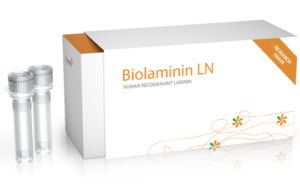
Biolaminin 521 LN (LN521)
Full-length human recombinant laminin-521
Biolaminin 521 LN is a full-length laminin-521 substrate—the natural laminin for pluripotent stem cells, reliably facilitating ESC and iPSC self-r […]